Blackout in Southern Europe: why battery storage is essential for grid security
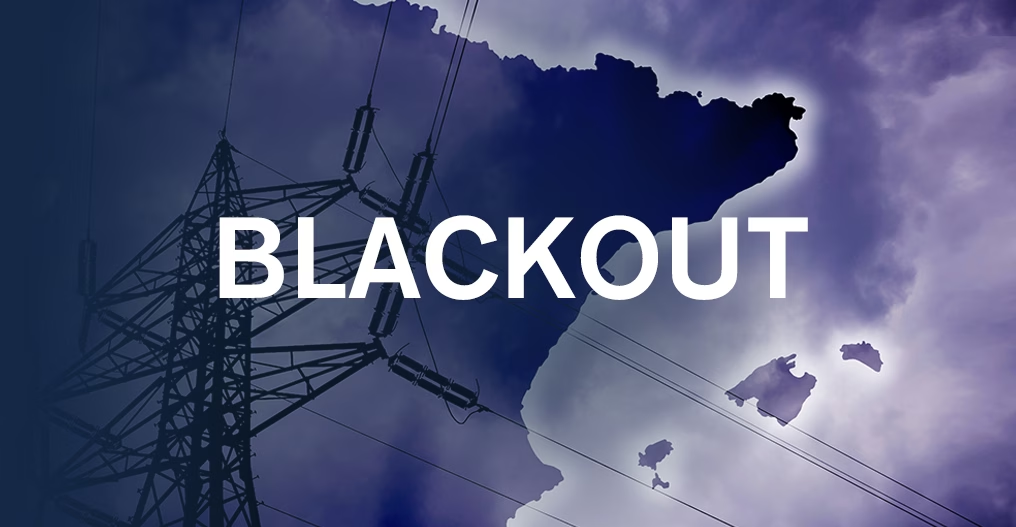
A moment of darkness and suddenly everything stops. Trains come to a halt, data centres lose their connection, even critical infrastructure begins to waver. A true horror scenario. What sounds like science fiction recently became reality in Southern Europe. The blackout of April 2025 shows us that the energy future is not merely a question of sustainability – it is a question of security. And at the heart of it stands a technology that hardly anyone sees, but keeps everything stable: battery storage.
Introduction: The reality of a power outage
What sounds like a scenario from a disaster film became bitter reality on 28 April 2025. In Spain, Portugal, and parts of France, electricity fell out across the board within seconds. The blackout crippled cities, stopped traffic, and even presented hospitals with major challenges. The cause: a sudden loss of 15 gigawatts of power that the European electricity grid could no longer compensate for.
An event of this magnitude reverberates far beyond the affected countries. It was a wake-up call that even in highly developed energy markets, grid stability is no longer something that can be taken for granted.
A more fragile balance due to renewable energy
The energy transition is advancing, but it brings new risks with it. The increasing share of volatile energy sources like wind and sun makes grid control more difficult. Conventional power plants, which until now ensured continuous base load, are increasingly being scaled back or taken offline entirely.
This increases the danger that even small deviations in power generation or consumption can have serious consequences. The grid frequency, which is critical for overall system stability, reacts sensitively – and in extreme cases can become unbalanced, as the Southern European example demonstrates.
Battery storage as a strategic security reserve
Large-scale battery storage is gaining a key role in this new energy world. They are capable of reacting with lightning speed to frequency deviations and thereby defusing critical situations. Not primarily conceived as seasonal energy storage, but as a precisely controlled tool for grid stabilization.
Their contribution lies primarily in absorbing short-term fluctuations before they spread systemically. Where previously inertia in the turbines of coal or nuclear power plants provided security, today high-performance batteries handle this task – only much faster and more flexibly.
Moreover, battery storage is increasingly becoming an economic factor. Costs are falling continuously, and new regulatory frameworks are creating incentives for deployment in various market areas – from frequency regulation through load management to balancing energy marketing.
Switzerland in the European context
Switzerland still benefits from a relatively stable power mix. The high availability of hydropower and the presence of nuclear energy currently provide a solid foundation. However, the share of solar energy is also increasing noticeably here, particularly during the summer months.
At the same time, Switzerland is closely linked to its neighbouring countries via the European interconnected grid. Disruptions in adjacent regions can thus very quickly have impacts on domestic grid stability. Those who believe that a blackout like the one in Southern Europe is inconceivable here are underestimating the mutual dependencies within the European electricity market.
Act now – before it becomes critical
The recent incident was a wake-up call. It has shown how fragile our electricity supply has become – not just in the south, but also in the seemingly well-protected regions.
Battery storage is neither a gimmick nor a purely technical detail. It is a strategic instrument for ensuring our electricity supply remains secure, stable, and economically viable in the future. Whoever invests in this technology early not only strengthens their own system, but increases the resilience of the entire infrastructure.
Are your systems, networks, or projects already prepared for this new energy era? We show you how battery storage can be tailored and economically integrated into existing systems – whether for municipalities, energy suppliers, or industrial operations.