wattss-INSIDE: expert knowledge on battery technology and BESS safety
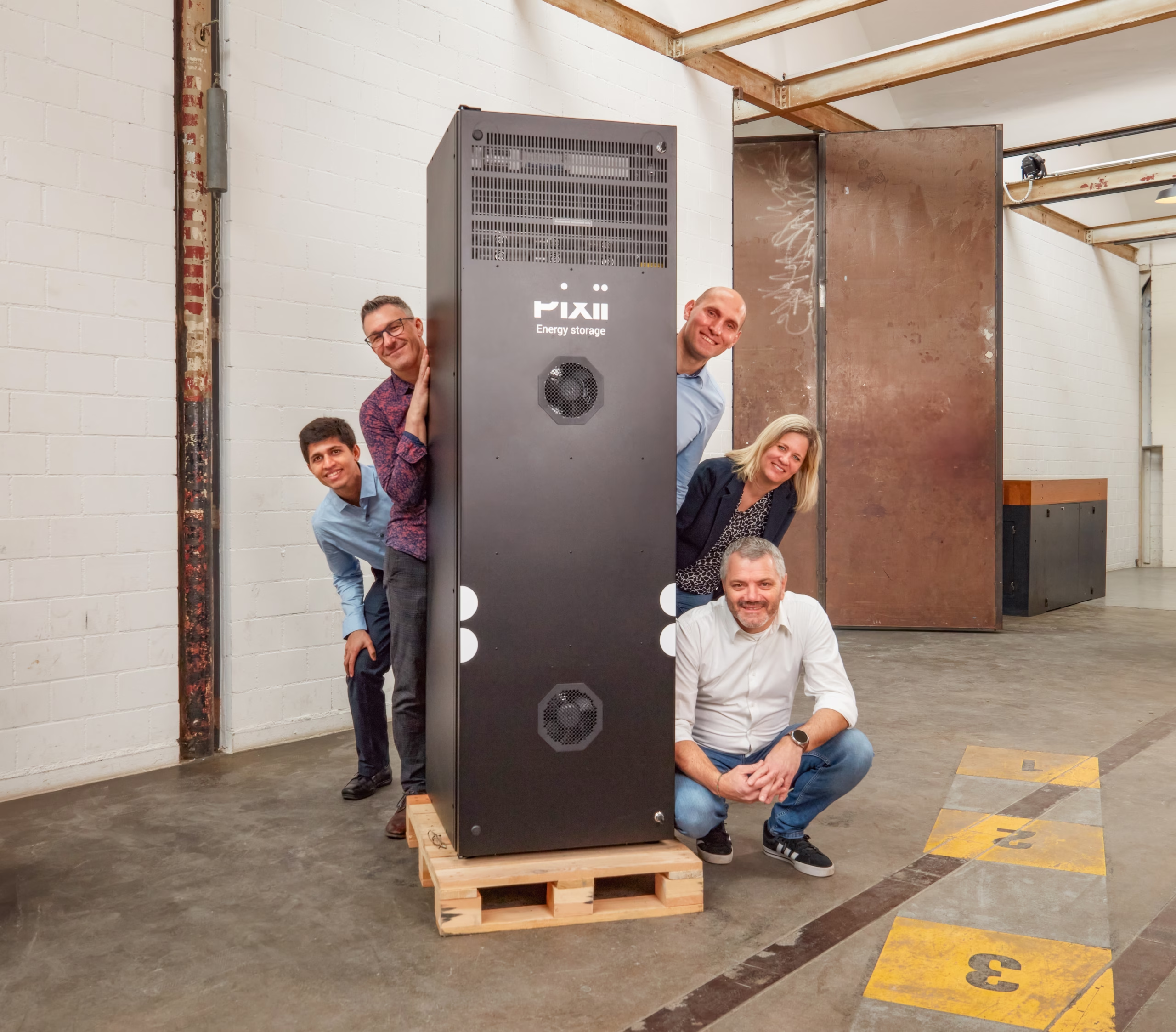
Which battery technologies dominate the market? How are Battery Energy Storage Systems (BESS) structured, and how safe are they? Thomas Prohaska, Project Manager and battery technology expert at wattss, provides exciting insights directly in our series “wattss-INSIDE” with expert knowledge in an interview.
After studying electrical engineering at ETH Zurich, he specialized in sustainable energy and mobility solutions and worked as a Systems Engineer for traction systems and Product Manager for high-voltage batteries.

Welcome to our conversation today about Battery Energy Storage Systems (BESS)! We are delighted to speak with Thomas Prohaska, Project Manager and battery technology expert at wattss. Thomas, you studied electrical engineering at ETH Zurich and specialized in sustainable energy and mobility solutions. Can you give us a brief overview of which battery technologies are currently most commonly used in BESS?
Most battery energy storage systems (BESS) today are based on lithium-ion technology. Particularly common are the cell chemistries LFP (lithium iron phosphate) and NMC (nickel-manganese-cobalt). LFP is considered particularly safe, thermally stable and long-lasting – and moreover it comes completely without cobalt, which is an advantage from a sustainability perspective. For stationary applications like BESS, where energy density is not as critical, LFP is the dominant cell chemistry. NMC remains attractive for particularly performance-critical applications like e-mobility. For sustainability reasons, efforts are being made to reduce the cobalt content contained in it as much as possible.
In addition to these established technologies, alternatives such as sodium-ion or solid-state batteries are gaining increasing relevance. Sodium-ion batteries use similar technologies and manufacturing processes to lithium-ion batteries, but do not require critical minerals; instead, they use sodium, which is abundantly available in nature, making them a promising solution for sustainable BESS.
You have already mentioned the advantages of lithium-ion technology and specifically LFP cell chemistry. Nevertheless, there are ongoing new developments in battery research. Are there technologies that could become a serious alternative to LFP in the future?
At wattss, we are currently relying on proven LFP chemistry, which, as mentioned, is particularly widespread for static applications like BESS. At the same time, we are open to new, innovative technologies. Even though they are still more expensive than LFP today, we believe in their potential. Because technological changes take time – and we want to be there when new standards are established. If you are working on a new technology or offering an exciting solution, please feel free to get in touch with us – we are always open to a conversation to explore possible synergies or collaborations (laughs).
Very exciting! Let’s now take a closer look at the structure of a battery energy storage system. Many people often only think of a large battery – but a BESS is far more complex. Can you explain which components make up such a system and what role they play?
A BESS is far more than “just” a battery – it is a complex system of several components that together provide safe, efficient and flexible energy storage. At the heart of electrical energy storage are the battery cells and modules. The battery management system (BMS) ensures safe operation. It monitors voltage, temperature and state of charge of each individual cell in real time and protects against overcharging, deep discharge or overheating. Another central element is the inverter, which converts the direct current (DC) supplied by the batteries into grid-compatible alternating current (AC). Depending on the system architecture, the inverter can be integrated in the battery container or installed separately. After the inverter, the connection to the power grid is made via a transformer. Which voltage level is used – low, medium or in rare cases even high voltage – depends on the technical conditions of the grid connection point. This could be, for example, a nearby substation or an existing transformer station. The respective grid operator specifies at which voltage level a connection is possible and what feed-in capacity can be realized. These framework conditions significantly influence the design of the BESS. There are two areas of application to distinguish:
- Behind-the-Meter:
The BESS is located “behind the meter” of a consumer, e.g. in a commercial business or for an industrial customer. Here it is used for self-consumption optimization, peak shaving or emergency power supply.
- Front-of-the-Meter:
The system is connected directly to the public grid and operates independently of a specific consumer. In this case, it is often used for grid stabilization, energy market trading or buffering renewable energy.
Applications, depending on whether the system is installed behind or in front of the meter. What other aspects need to be considered to operate a BESS efficiently and profitably?
To control all energy flows, an overarching Energy Management System (EMS) is used. It regulates charging and discharging processes, optimizes self-consumption, controls grid support functions such as peak shaving or frequency regulation – and networks the BESS with other generators and consumers.
We at wattss offer different solutions: from behind-the-meter systems to AC-compatible complete solutions for the low-voltage grid – preferably together with our partner Pixii – to large-scale BESS projects in the two to three-digit MWh range, where we – wherever possible – use European components.
Beyond technological efficiency, an especially important topic is the safety of battery storage. Especially with lithium-ion batteries, there are often discussions about fire risks. How safe are modern BESS really, and what protection mechanisms are used?
The safety of battery storage is today very high thanks to mature technology and strict standards – provided the system is professionally designed, installed and operated. Modern lithium-ion batteries, particularly with LFP chemistry, are considered thermally stable and less reactive than earlier cell types. Nevertheless, a multi-stage safety architecture is essential.
A key element is the battery management system (BMS), which continuously monitors each cell – it intervenes automatically if critical deviations occur. In addition, fire protection concepts, temperature sensors and emergency shut-downs ensure that rapid action can be taken in the event of an emergency. The system design itself also plays a role: ventilation, separation of battery modules, fire alarms and gas-tight enclosures increase operational safety.
You have mentioned that modern battery storage meets very high safety standards. Are there specific studies or comparisons that support this assessment?
A professional safety concept takes into account not only the battery, but goes much further; the interaction with inverter, grid and building services must also be well coordinated. In practice, this means: batteries today are just as safe as other electrical installations – when properly planned and operated. That this assessment is not just theory is also shown by current studies: A study by RWTH Aachen demonstrates that stationary battery storage does not increase the fire hazard in residential buildings – they are even considered safer than many household appliances:
With our energy storage solutions, we rely on proven technologies that have been tested according to international standards. A central test criterion is, for example, the so-called Thermal Propagation Test according to IEC 62619. This must demonstrate that a thermal runaway – i.e. an uncontrolled thermal runaway of a cell – cannot spread to adjacent cells. In addition, we work exclusively with experienced partners who have comprehensive expertise in the implementation of safe and efficient battery storage solutions – from system design to commissioning on site.
Thank you, Thomas, for these profound insights! It becomes clear that the technology behind battery storage is far more mature and safer than many think. Finally: where do you see the greatest opportunities and challenges for BESS in the coming years?
In addition to the technical aspects, we currently see some key challenges in project execution. A significant bottleneck is currently the processing of grid requests. Grid operators are heavily loaded because the number of projects in the area of renewable energy, electromobility and storage solutions is constantly increasing. In many cases, this leads to extended processing times, which can have direct impacts on project timelines and commissioning dates.
At wattss, we respond to this with early planning, close coordination with grid operators and standardized processes. Where possible, we involve our partners early in the project phases – this creates clarity and enables realistic schedules.
In addition, you have to keep an eye on the regulatory and political framework – because storage projects run over many years. Through forward-looking planning and flexible concepts, we ensure that our systems can be operated successfully in the long term.
An exciting prospect! Thank you, Thomas, for this enlightening conversation. And to all listeners and readers: stay informed about the latest developments in energy storage – visit our website for more exciting content!
The future of energy supply will be significantly shaped by efficient and safe battery storage. Our conversation with Thomas Prohaska has made it clear how important the right technology selection, well-thought-out system design and the highest safety standards are for the successful use of BESS.
At wattss, we rely on proven solutions but are always open to innovations. Are you working on new technologies or looking for a strong partner for your energy storage project? Let’s get in conversation!
Stay up to date and discover more exciting insights: beratung@wattss.ch or +41 58 590 20 50.